Transforming Quality Control with Scalable AI
A North American wallboard manufacturer identified inefficiencies in its traditional bubble density and structural integrity testing, and began strategizing an improved process. The manufacturer produces thousands of sheets per hour, each assigned a specific grade that drives pricing, market positioning, and end-use application, but its established testing protocol created a costly bottleneck. Partnering with RoviSys enabled a smart solution with measurable results.


The Challenge
When a leading North American wallboard manufacturer identified inefficiencies in its traditional bubble density and structural integrity testing, it began strategizing an improved process. The manufacturer produces thousands of sheets per hour, each assigned a specific grade that drives pricing, market positioning, and end-use application, but its established testing protocol created a costly bottleneck.
The reality: Production teams cut samples, manually labeled them, and sent them to a lab for bubble density analysis, creating long visibility gaps of 10 minutes or more. At production rates of roughly 2,000 sheets per hour, that delay meant hundreds of sheets were manufactured without quality confirmation, putting premium product at risk of being underpriced and increasing the chance of unsellable, off-spec material.
The manufacturer’s data science team identified a potential answer: use computer vision and machine learning to predict quality in real time and eliminate the lab-testing bottleneck. They knew what the model needed to do, but lacked the in-house expertise to operationalize it in a live production environment.

Our Role: Strategic Innovation Partner
To move quickly, the manufacturer first engaged EESCO (Englewood Electric Supply Company, now a division of WESCO International, Inc.) to source cameras for a vision-based system. EESCO brought in RoviSys, recognizing that the opportunity went beyond hardware and would require systems integration experience and Industrial Artificial Intelligence expertise.
This was the manufacturer’s first project with RoviSys, and time-to-deployment became the focus. Working with a lean RoviSys team that included a project manager, a technical lead, and one engineer, the manufacturer’s data science group set out to turn a promising model into a robust, production-ready system that could be replicated across multiple sites.
The manufacturer had a data science team that knew what they wanted to do but didn’t know how to put the model into production. That’s where RoviSys made an impact

The Solution: Operationalizing AI and Production Speed
The manufacturer and RoviSys joint team aligned around a clear objective: build a computer vision system that would analyze product quality in real time and predict grade classification with the same accuracy as traditional lab testing, but at line speed.
RoviSys designed a two-part AI solution:
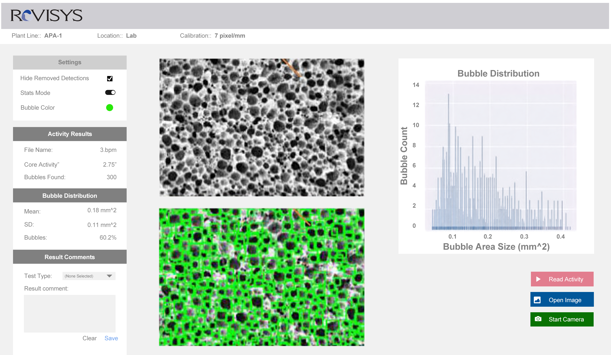
- Computer vision feature extraction: Using Roboflow, the team built a vision model trained on cross-section images of the product to identify key quality indicators like bubble count, size, density, and distribution patterns, turning visual characteristics into grade prediction features.
- Neural network classifier: A classification model, trained on historical lab data, learned to correlate these bubble characteristics with the grades that lab testing would have assigned, enabling accurate, automated grade prediction.
The system was intentionally simple and practical, but the strategy required creative innovation to execute. It ran on USB cameras mounted in 3D-printed housings, with operators accessing the application through a standard web interface. No specialized hardware or lengthy operator training was required.
Manufacturer + RoviSys = Smart Collaboration
From concept to production, the partnership focused on making AI usable and scalable in real operations. Key elements included:
- AI model development that combined the manufacturer’s domain and data science knowledge with RoviSys integration expertise.
- Seamless production integration at five initial sites, aligning with existing workflows and controls.
- Scalable architecture that created a low-cost, web-based architecture designed from the start for replication across additional facilities without requiring ongoing RoviSys involvement.
By staying focused on the manufacturer’s operational goals and constraints, the joint team created a solution that fit naturally into daily work on the plant floor.

The Result: Real-Time Insight, Network-Wide Impact
In less than 6 months, the manufacturer had a working system in production, delivered on schedule and under budget. The impact extended well beyond the initial lines:
- Real-time quality feedback eliminated lab testing delay, giving operators immediate visibility at production rates exceeding 2,000 sheets per hour.
- Reduced quality risk closed the production-to-quality gap, protecting premium product value and lowering scrap risk.
- Exceptional scalability enabled the manufacturer to independently roll out the solution to 12+ additional sites after the initial deployment.
- Cross-industry reuse allowed a sister company to adapt the same approach for container glass quality control.
- Cost-effective implementation using materials under $50 per station made rapid scaling attainable.
For the manufacturer, the project proved that simple, well-executed industrial AI solutions can deliver outsized value when tightly aligned to real operational challenges. For RoviSys, it established a trusted role as a partner that can bridge the gap between data science concepts and production-ready industrial systems that help manufacturers turn their own ideas into measurable results.