Cooling an Iconic Facility for the Future
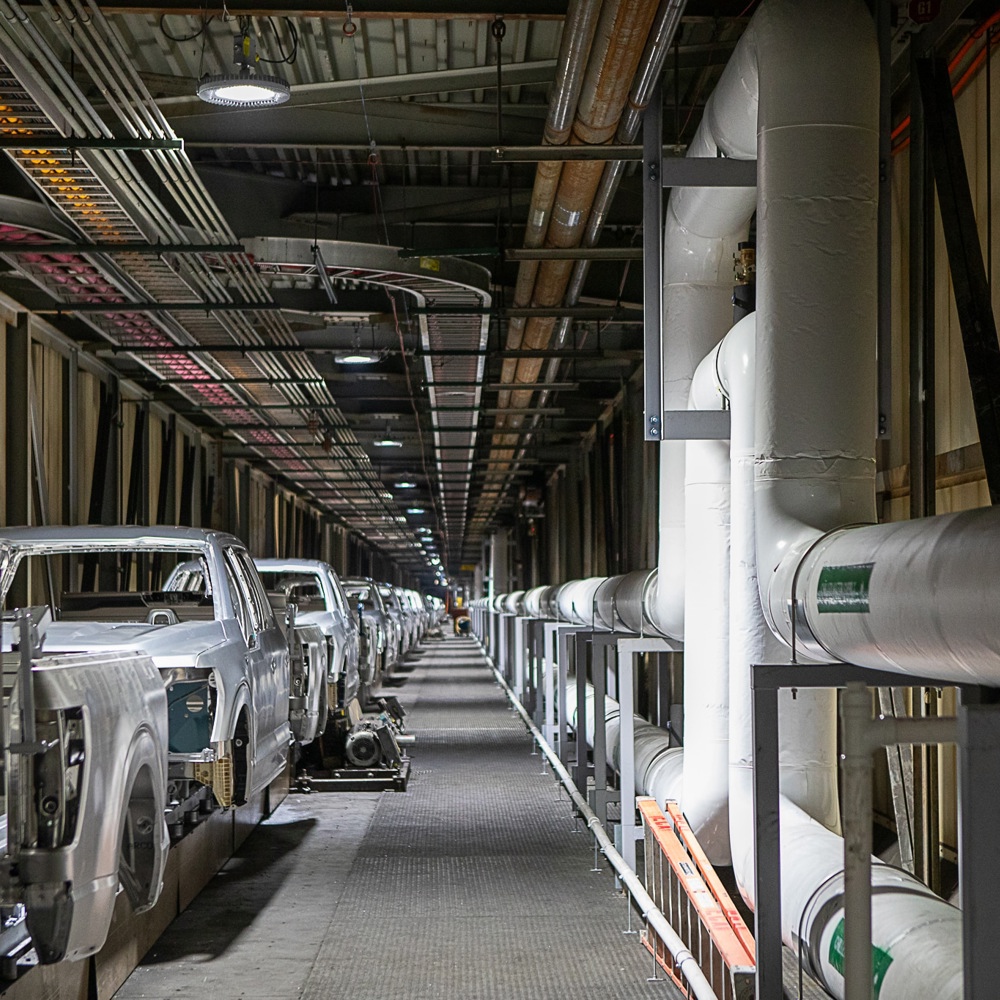
A leading U.S. automaker needed to modernize the cooling infrastructure at one of its most critical manufacturing hubs—a 4.5-million-square-foot flagship assembly plant where thousands of employees work daily. After decades of expansions and aging equipment, summer temperatures regularly climbed above 120°F, affecting worker safety, production quality, and overall reliability. RoviSys Building Technologies was selected as the trusted systems integration partner to bridge legacy infrastructure with modern cooling technology, supporting both the automaker and its OEM partners while keeping the plant fully operational throughout the upgrade.

The Problem
A leading U.S. automaker needed to modernize the cooling infrastructure at one of its most important manufacturing hubs—a 4.5 million square foot flagship assembly plant that has anchored the company’s operations since the 1950s. The site, located in the Midwest, produces several of the company’s most profitable vehicle lines and remains one of the highest-performing facilities in the automaker’s global network. Thousands of employees work at this plant every day, making its environment and infrastructure
critical to safety, quality, and productivity.
Over time, continuous expansion and aging equipment had pushed the facility’s original cooling systems to their limits. During summer months, temperatures in some production zones regularly exceeded 120°F, compromising worker comfort and safety, paint quality, and machine reliability. Union agreements required the automaker to address temperature conditions, making a comprehensive system upgrade a top priority.

Our Role
RoviSys Building Technologies (RBT) was selected as the trusted systems integration partner based on a long standing relationship with the automaker and deep expertise in complex infrastructure modernization. Our team was brought in to support both the automaker and its OEM partners, bridging legacy systems with modern technology while keeping the plant fully operational throughout the upgrade.
Scope of Work
- Controls Strategy: Developed a modular, scalable controls strategy for chillers, air handlers, and the BMS to ensure precise coordination and temperature regulation across the facility.
- Controls and Commissioning: Designed and implemented controls for dual- tunnel air handler units and executed seamless commissioning.
- Modular Chiller Plant: Partnered with the OEM to test, assemble, and commission a 9,000-ton modular chiller plant (150 ft x 100 ft); purpose-built for high-capacity cooling.
- Humidity Management: Engineered a smart dew-point control solution using humidity sensors to minimize condensation, rust, and water leaks—eliminating the need for expensive insulated ductwork.
Today, this flagship assembly plant is not only cooler and more efficient, but also more resilient and future-ready, setting the standard for infrastructure modernization across the automaker’s global network.

The Solution
The project launched in summer 2023 with an aggressive, 12 month timeline of full cooling capability by summer 2024.
RoviSys Building Technologies deployed a team of engineers and project managers familiar with the automaker’s standards and technology stack to deliver a hybrid control architecture integrating both modern and legacy systems:
- Air Handler Systems: Niagara Tridium controllers were used to align with the automaker’s existing BAS ecosystem.
- Chiller Plant: Implemented on a Rockwell ControlLogix platform with Point I/O chassis to enable high availability and redundancy.
- System Coordination: Updated global control logic to avoid unintended heat loads and maintain consistent temperature regulation across multiple buildings.
The modular chiller plant feeds six existing Big Foot units, five legacy HVAC units, and over a dozen new units—expanding cooling capacity, improving system resilience, and ensuring future scalability.

The Result
By mid-2024, the assembly plant had undergone a major transformation.
Cooler, Safer Environment: Temperature conditions improved dramatically, creating a safer and more comfortable environment for thousands of employees.
Operational Efficiency: Enhanced cooling stability improved paint quality and equipment performance.
Smart Seasonal Flexibility: The system now automatically transitions between summer and winter modes while allowing manual control when needed.
Standardization: Established documented control frameworks and plant standards that the automaker plans to replicate at other large sites.
The project strengthened collaboration between the automaker, OEMs, and union stakeholders. RoviSys acted as the integration “glue” that enabled a smooth modernization effort at a high volume production site without disrupting daily operations.
Today, this flagship assembly plant is not only cooler and more efficient, but also more resilient and future-ready, setting the standard for infrastructure modernization across the automaker’s global network.